
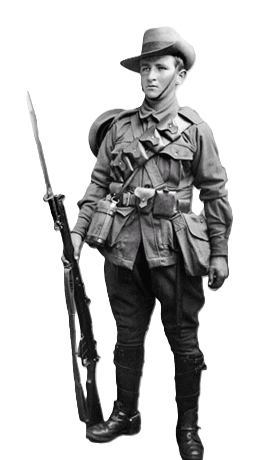
Australia in World War 1
Australia entered the First World War in August 1914 as part of the British Empire. Although the nation had been federated for only thirteen years, support for Britain was widespread, and thousands of Australians volunteered for overseas service. Over the course of the war, more than 416,000 Australians enlisted from a population of fewer than five million.
Australia’s first military action was the seizure of German possessions in New Guinea and the Pacific by the Australian Naval and Military Expeditionary Force. The main Australian force, however, was the Australian Imperial Force, or AIF, which trained in Egypt before joining the Allied campaign against the Ottoman Empire at Gallipoli.
Australian and New Zealand troops landed on the Gallipoli Peninsula on 25 April 1915. The campaign aimed to capture the Dardanelles, weaken the Ottoman Empire and open a supply route to Russia. The landings met strong resistance, and the troops endured steep terrain, disease, heat and heavy casualties. The campaign failed, and Allied forces withdrew in December 1915. Gallipoli nevertheless became central to Australia’s national memory, and 25 April is commemorated as Anzac Day.
From 1916, most Australian infantry divisions fought on the Western Front in France and Belgium. Australians took part in major battles including Fromelles, Pozières, Bullecourt, Messines, Passchendaele, Villers-Bretonneux and the Allied offensives of 1918. These battles were marked by artillery bombardment, trench warfare, mud, gas and enormous loss of life. Australian forces developed a strong reputation for courage and effectiveness, but their achievements came at great human cost.
Australian mounted troops also fought in the Middle East, particularly in Sinai, Palestine and Syria. The Australian Light Horse contributed to victories at Beersheba and elsewhere, helping defeat Ottoman forces in the region. Australian naval and flying personnel also served in several theatres.
On the home front, the war transformed Australian society. Governments introduced censorship, recruitment campaigns and wartime controls. Two bitter referendums on conscription, held in 1916 and 1917, were defeated and deeply divided the country. Women supported the war effort as nurses, workers, fundraisers and volunteers, while many families experienced grief and hardship.
By the Armistice on 11 November 1918, more than 60,000 Australians had died and over 150,000 had been wounded, gassed or taken prisoner. Australia’s participation strengthened national identity and international recognition, but left a lasting legacy of trauma, loss and commemoration. Its wartime service continues to influence Australian ideas of sacrifice, citizenship, mateship and remembrance.