A short history of the Yeronga RSL sub-branch
Taken from We will remember them: A history of the Yeronga-Dutton ParkRSL Sub-Branch and Yeronga Services Club, Margaret Puller, 1999.
The Yeronga Community Hall
In 1909 funds were being raised for the construction of a community hall located at the corner of Fairfield Road and what became known as Kadumba Street. The deeds to the land show that on 26 July 1909 Edward Denny Day, Alexander McNab, Ernest George Edward Scriven, William Alfred Rigby and John Clarke Kenyon became trustees of the land and the hall. The hall was opened with a dance evening on Tuesday 24 August 1909 where Mr. Denham, the Legislative Assembly member for Oxley, spoke and congratulated the residents on the erection of the gas-lit hall.
The hall was a community centre and during WWI the Red Cross and other dedicated community members used the hall to raise money for the benefit of the war effort, and for wounded and returned soldiers. The first Welcome Home for returned soldiers was held at the hall on 11 July 1916.
William Alfred Rigby was a long-time resident of Yeronga and he helped to raise funds for the construction of the hall and for the families of returned soldiers. In 1915, Mr & Mrs Rigby’s four adult children enlisted for service. The eldest sons, Jack and George enlisted in the 9th Battalion and landed at Gallipoli on 25 April 1915. Jack, a young Lieutenant, was killed on that first morning, and George, a corporal, was seriously wounded that afternoon.Julie their sister served in India in the Australian Army Nursing Service, and brother Gordon enlisted in 1916 and served in the Field Artillery.
William Alfred Rigby was a long-time resident of Yeronga and he helped to raise funds for the construction of the hall and for the families of returned soldiers. In 1915, Mr & Mrs Rigby’s four adult children enlisted for service. The eldest sons, Jack and George enlisted in the 9th Battalion and landed at Gallipoli on 25 April 1915. Jack, a young Lieutenant, was killed on that first morning, and George, a corporal, was seriously wounded that afternoon.Julie their sister served in India in the Australian Army Nursing Service, and brother Gordon enlisted in 1916 and served in the Field Artillery.
Younger brother Hubert was wounded in WW II. Mr Rigby’s benevolent contribution to war service issues and his family’s significant war service were acknowledged when the Sub-Branch together with the Brisbane City Council, with support from Councillor Nicole Johnston, dedicated the site of the previous Yeronga Military Hospital as Rigby Place in honour of this man and his family. The first tree on the Park Road end of Honour Avenue was planted in honour Jack Rigby. His father, William died on 8 May 1922.
Yeronga Sub-Branch
The Yeronga Sub-Branch of the R.S.L. was formed in 1934 and received its Charter of Membership of the Returned Sailors and Soldiers Imperial League of Australia (RSSILA). On 11 February 1935 it was reported in the Telegraph that a new sub-branch of the RSSILA was launched at the Yeronga Community Hall.
Little is known about the early membership of the Yeronga Sub-Branch in the first years after 1935 as the records have not survived, though the identity of the presidents were recorded on the honour boards. The inaugural president was Dr Ernest Culpin, followed by Dr. J. G. Avery, H. Williams and A. L Mercer the fourth and the 1939 president. Most of the early committee members had served in WWI and were prominent local citizens, including Hec Williams, the Queensland Manager of the Scottish Union Insurance Company and the Yeronga Scout Master, Edward (Ted) Malone. Ted was actively involved for many years, was the president in 1945 and four years later he was the first person to be granted a life membership of the Sub-Branch. This award for service was granted by the National body.
The Sub-Branch carried out their many activities at the Yeronga Hall and in 1938 they became members of the governing committee of the hall. The events conducted during the first years included a ball, a children’s fancy dress ball, a fete, smokos, a children’s Christmas tree and a reunion. Early on, the Sub-Branch supported and prospered from its links with the newly formed Yeronga Bowls Club, and the promoted activities included girl dancing classes, a ladies’ bowls event and an Armistice Day Cup. These all required trophies, thereby providing opportunities for the Sub-Branch’s charitable support.
World War II and thereafter
There are no records of activities undertaken by the Sub-Branch during the World War II years. However, during this war the Americans commandeered Yeronga Park, the Moorooka State School and other localities and they established camps and hospitals across the area. The war bought fundamental changes to the Sub-Branch, especially with the inclusion of Airmen in the RSSILA to become the Returned Sailors, Soldiers and Airmen Imperial League of Australia (RSSAILA). Consequently, the Sub-Branch experienced a period of growth and in 1946 between 10 and 20 ex-servicemen joined every month and the membership increased with the formation of the Women’s Auxiliary on 27 July 1946. The new members introduced life and energy into the organisation and the attendances at meetings and functions increased as did the income received.
The Memorial Hall
In 1946 the Sub-Branch secretary began searching for a new home and a sub-committee was established to consider the acquisition of the Yeronga Community Hall. In 1947 a meeting was convened between the secretary, George Mocatta and the trustees of the hall. An agreement was reached in 1947 with the effect that the Hall was to be handed over to the Sub-Branch, on condition that the Hall was to be made available for other community uses.
By 1949, the Sub-Branch had an average of 30 persons attending its meetings. Secretary Bill Tuite was the master of activities and the organized functions included the successful Christmas tree event, weekly dances and the ball. These events were outstanding successes both socially and financially. The annual fete raised £100 (pounds). The Sub-Branch supported the Yeronga State School, its members visited this and other schools to educate students about Anzac Day and this was followed by an essay competition. Additionally, sporting initiatives for members were commenced including indoor bowls and a hearty link was established with Chardons Hotel.
In 1951, facilities in the building were improved, with new plumbing, improved lighting and general improvements. A caretaker’s cottage and kindergarten were added to the ground floor.
In 1953 responsibility of the hall was vested in the hands of the Yeronga Sub-Branch and the Queensland Trustees Limited became the trustee on 5 March 1953.
The Sub-Branch was performing very strongly due in part to its control of the Memorial Hall. It not only provided a home, it was also an income generator, being regularly booked throughout the year. It was the base for the Yeronga 3rd Scout Group, it was used for dancing, concerts and meetings of the Liberal Party, the Masonic Lodge and Christian Assemblies.
After the loss of Bill Tuite in 1952, the Sub-Branch suffered a decline in its membership and social activities. Consequently, the president warned that it was foolish to continue the activities of the Sub-Branch on the scale of previous years. By 1956 the annual reunion was abandoned, the sports club went into recess and the 1957 annual general meeting had to be cancelled, despite membership drives. The spiral downwards continued.
The Yeronga Dutton Park Sub-Branch
However, external factors soon came into play. In 1963, it was rumoured that the neighbouring Dutton Park Sub-Branch was about to lose its meeting venue at the local Scout Hall. The fortunes of this Sub-Branch mirrored the successes of the Yeronga Sub-Branch since the cessation of World War II. With a strong membership, Dutton Park, although homeless, was a very strong Sub-Branch. It had a long record in initiating social activities; in recruiting and engaging its members; in providing all manner of superb activities; and supporting a vast array of community activities, as well as possessing expert leadership.
Discussions were had, and at a General Meeting in December 1963, the Yeronga Sub-Branch agreed to merge with that of Dutton Park. On 3 February 1964 the Yeronga – Dutton Park Sub-Branch was granted its charter, and a committee was formed with representatives from both Sub-Branches.
In 1969, the land was legally vested in the Trustees of the Yeronga-Dutton Park Sub-Branch.
With the union of these Sub-Branches, and the increase in membership, and an increase in the mix of skills and experience, the new Sub-Branch prospered. The State President visited in 1965 and commented that: "Yeronga–Dutton Park stands well in the eyes of the State".
In 1973, President Joe Wilkinson with his “operation rejuvenation plan” aimed at revitalising the Sub-Branch, was able to declare that:
as a result of this policy the Sub-Branch has established a Services Club with a membership in excess of 360 and still increasing, and to support a Sub-Branch Membership with 120 financial members, made up mostly of those who have re-joined.
Yeronga Services Club
In 1973 a significant milestone occurred in the Sub-Branches history, with the formation of the separately incorporated Yeronga Services Club (the club), which became a key financial and community supporter, and sometimes the bedrock for the Sub-Branch. As well, it immediately became a key asset for the wider community as witnessed in its role in providing crisis premises for a bank which had been destroyed in a typhoon; for donating financial support for members of the Darwin Sub Branch after Cyclone Tracey; and its role in assisting the State Emergency Service in the 1974 Brisbane floods, as well as supporting numerous members affected by the same flood.
More importantly, the club has continued for almost 50 years to become a major social and leisure centre for the entire district. Visitors to the club were attracted to the Sub-Branch and many joined, and the club has assisted the Sub-Branch both financially and socially as it supports a wide array of community welfare and sporting bodies.
A new building
However, these years had not been without their challenges. With the new enthusiasm after the merger, they were still stuck with the old ageing hall. It was just not good enough to support the expansion of membership and the community activities that they all flocked to. One of the great needs was a bar and a coldroom that required a liquor licence. The Licence Authority was far from impressed with the standard of the old building. It was clear the hall was by far too small and unsuitable for all of its purposes, particularly to establish an attractive club, and the many activities such as bingo that was to take place in the building.
The club turned to the Sub-Branch to assist with obtaining a loan sufficient to construct an entirely new building on the same site. In 1981, the Sub-Branch was able to secure a loan of $382,000 from the State Government Insurance Office with the Bank of NSW as the guarantor. The loan facility was a significant reason a liquor licence was granted. The old hall soon came down as the first section of the new building was commenced. The new premises was built in two stages, the first stage was opened on 19 April 1982, the hall was then demolished and the second stage was erected.
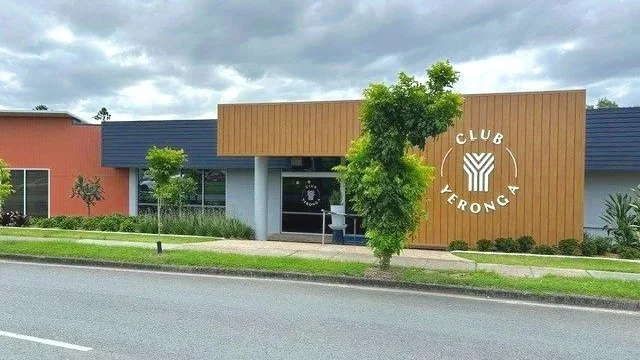
The new building, which is basically the foundations of the one we are sitting in here today, was officially opened by the Governor of Queensland, Sir James Ramsay, on 17 July 1982 with enormous fanfare.
The Commanders of the three Services were present, Cabinet Ministers, the National and the State Presidents of the RSL, with an Honour Guard – the same Guard that was in training to be the Honour Guard for the opening of the Commonwealth Games. The RSL president presented the Sub-Branch the Bofors anti-aircraft gun to mark the occasion.
Throughout those preceding and frustrating 10 years, the club would never have got to this point if it wasn’t for the growth in every aspect of the Sub-Branch and the club. This was attributable to the support of hundreds of members of the Sub-Branch, the club, as well as almost every community and charitable and sporting group in the district. Time does not permit the telling of this fantastic story, which is really, a story of the building of the Yeronga and Dutton Park communities as well. But it was not without some very dark times, when those responsible were forecasting the end of the whole project.
Gambling
The next 20 years saw committee members come and go, some quite brilliant others less so, but this was in the days without gaming machines. In Queensland, charitable clubs were confined to operating “in line” machines and they provided a profit to the club of $62,000. However, after the Fitzgerald Royal Commission into corruption, these machines were outlawed, proving disastrous to the club.
In 1984 the RSL membership was opened to all members who had served in the Defence Services, which meant “that you only had to have smiled at a Recruiting Officer to become a member of the League these days”. Also, in 1984, Yeronga involved itself seriously and successfully in welfare work regarding the needs of ex-servicemen and women.
Once again, by 1989, the club hit rock bottom due to its limited income. It could barely pay its loans. It wasn’t until 1992 when poker machines were allowed in clubs in Queensland that its position changed. Apparently, the club was barely four weeks from closing its doors.
The club seized the opportunity and quickly installed 50 machines with local character Ernie Seaton inserting the first coin. President Pat Dunshee declared: "The introduction of Poker Machines into Queensland has been like a shot in the arm, particularly for our club. After years of frustration where every progress was foiled by restrictions, we are at last seeing the light at the end of the tunnel".
Immediately the club was able to be redecorated and refurbished. It also encouraged members to donate their own funds, including one donation of $100,000 for renovations. Eventually the building was extended in order to install another 32 machines. By 1998 an operational income of almost $1 million was achieved.
The Sub-Branch provides a fundamental service to the community by conducting two ANZAC Day Services every year, with attendances often in the thousands. Many organizations including churches, primary and high schools, organizations that support aged persons and sporting organisations have all benefited from the Sub-Branches support. In addition, it has provided mutual support to its sister Sub-Branches in the region such as Stephens, Coorparoo, Mt Gravatt – Holland Park, and Sunnybank. With these Sub-Branches it plays its role in the South Eastern District Association of RSL Sub-Branches.